For school leaders and estates managers, navigating the regulatory landscape around washroom provision can be genuinely confusing. Multiple pieces of legislation overlap, guidance has been updated at various points, and the consequences of getting it wrong extend well beyond a compliance tick-box – into safeguarding, pupil wellbeing and, increasingly, attendance.
This article sets out the key requirements clearly, and explores where best practice goes further than the legal minimum.
The legal framework
School washroom provision in England is primarily governed by the School Premises (England) Regulations 2012, supported by the DfE’s Advice on Standards for School Premises, most recently updated in 2015. Together, these set the baseline for what schools must provide.
The headline requirements are as follows:
- Toilet and washing facilities must be provided for the sole use of pupils
- Separate facilities for boys and girls must be provided for pupils aged eight and over, unless the toilet is in a fully enclosed, individually lockable room
- For pupils aged 11 and over who participate in physical education, suitable changing accommodation and showering facilities must be available
- Staff toilet facilities must be kept separate from those used by pupils, with the exception of accessible toilets, which may be shared
- Handwashing facilities must be provided in close proximity to every toilet
On ratios, the DfE guidance recommends approximately one toilet per 20 pupils as a general baseline, increasing to one per 10 for pupils aged two to four. At least one staff toilet with a washbasin should be provided for every 25 full-time equivalent members of staff.
Location and layout requirements
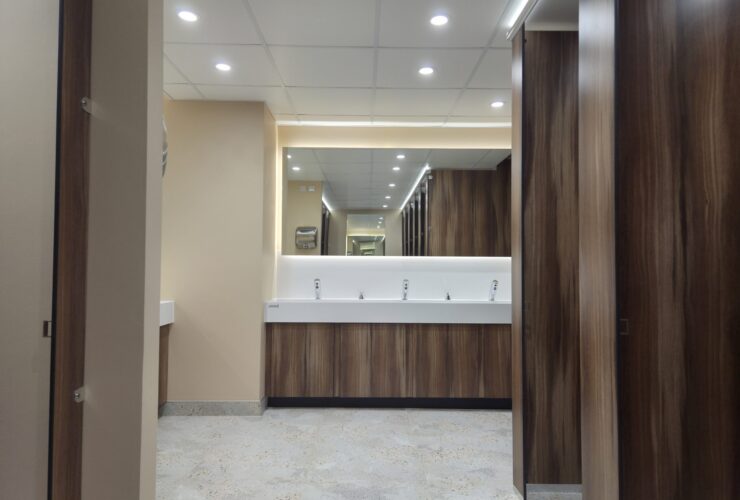
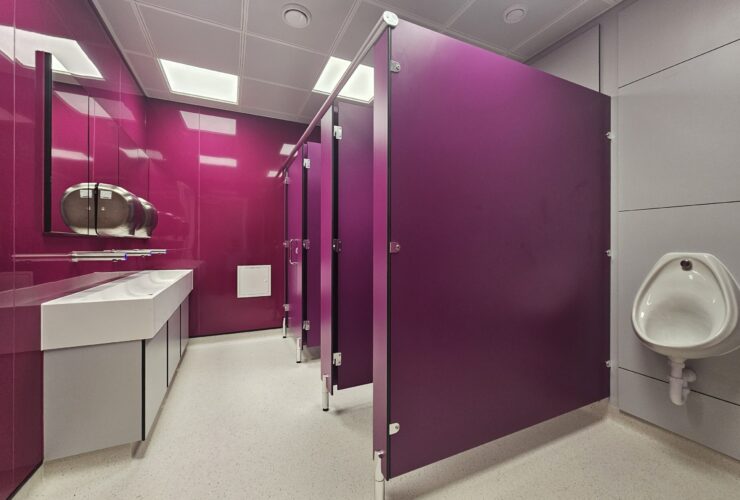
The regulations also address how facilities should be positioned and designed. Washrooms should be easily accessible to pupils, located so that informal staff supervision is possible without compromising privacy. Cubicles should provide genuine privacy – through adequate enclosure and secure locks – and ventilation and lighting must be sufficient to support safe, hygienic use.
These are minimum requirements. In practice, many school buildings – particularly older stock – fall short of what they require to comfortably serve current pupil numbers and expectations.
The DfE’s updated guidance on single-sex spaces
In 2025, the DfE published updated guidance on gender-questioning children, which placed school washrooms and changing facilities directly within a safeguarding framework. The guidance reinforces the importance of single-sex provision and asks schools to consider whether current facilities support the privacy, dignity and wellbeing of all pupils – not only those with specific needs.
For many schools, this has prompted a review of cubicle privacy, sightlines, access arrangements and the adequacy of existing layouts. Schools are not necessarily expected to undertake wholesale structural changes, but they are expected to demonstrate a considered, proportionate approach – and facilities that are clearly not fit for purpose represent a risk.
The guidance also has practical implications for how single-sex facilities are designated and communicated. Clear, consistent signage and policy alignment between physical provision and school procedures are increasingly expected as part of a school’s broader safeguarding framework.
For a detailed overview of what the guidance covers and what schools should be reviewing, see our dedicated article: School washrooms and the new DfE guidance — what schools need to know.
Where good practice goes further
Compliance sets the floor. The most effective school washrooms go well beyond what the regulations require. Evidence consistently shows that the quality of washroom facilities has a measurable impact on pupil behaviour, attendance and wellbeing. Poor provision – inadequate privacy, deteriorating finishes, unreliable fixtures – can lead pupils to avoid using facilities during the school day, with negative consequences for health and concentration.
Best practice in education washroom design considers:
- Robust, low-maintenance materials specified for heavy daily use in a school environment
- Anti-vandal design that discourages misuse without creating an institutional feel
- Layouts that support passive supervision while maintaining genuine privacy
- Accessible provision that serves pupils with SEND needs effectively, not just adequately
- Sustainability – water-efficient fittings, durable materials and reduced maintenance requirements
Planning ahead
For schools where current facilities are ageing, under pressure or failing to meet the standards outlined above, the right time to plan is before a problem escalates. A structured review of provision – against both regulatory requirements and the practical needs of the school – can identify priorities and support a credible business case for investment.
At Interfix, we work with schools, academies and multi-academy trusts to assess current provision and deliver refurbishments that are durable, compliant and genuinely fit for purpose – with project management approaches designed to minimise disruption whether works are delivered during holidays or in term time.
If you would like a free, no-obligation review of your school’s washroom provision, get in touch with our team.